Welcome To Website Of Dalian Really Fluid Technology Co., Ltd.


Characteristics of a water tank high-pressure cooling system
Jun 17,2025
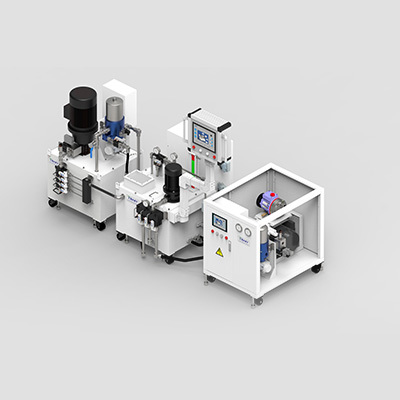
A tank-type high-pressure cooling system is a system that stores coolant in a tank and uses a high-pressure pump to deliver the coolant to the parts that need cooling. It is often used in industrial equipment and machinery processing, and its characteristics can be analyzed from several aspects:
I. Cooling Performance Characteristics:
High-pressure cooling is highly efficient: By using a high-pressure pump to eject the coolant at a higher pressure (usually reaching tens to hundreds of bar), it can quickly remove heat from the equipment or processing parts, resulting in fast cooling. This is especially suitable for high-load, high-heat generation scenarios (such as high-speed cutting in metal cutting processing).
Precise cooling positioning: High-pressure injection can precisely deliver the coolant to high-temperature areas, avoiding the problem of coolant diffusion and loss in traditional low-pressure cooling, and improving the targeting of cooling.
Strong anti-interference ability: The high-pressure water flow can penetrate obstacles such as chips and dust generated during processing, ensuring that the cooling effect is not affected by operating conditions.
II. Structural and Functional Characteristics:
Tank liquid storage and circulation:
The tank serves as a liquid storage unit. The capacity is designed according to needs and can store enough coolant to maintain continuous system operation.
Equipped with a filtration device (such as a filter screen or filter element) to filter impurities from the coolant, preventing nozzle blockage or equipment wear.
High-pressure pump drive: Uses high-pressure pumps such as plunger pumps and centrifugal pumps to provide stable pressure output, meeting the pressure requirements of different operating conditions.
Multi-pipeline and nozzle design: Multiple pipelines can be set up according to the distribution of cooling points, and different types of nozzles (such as fan-shaped and conical) can be used to achieve multi-point and multi-angle cooling.
III. Application Scenario Adaptability:
Suitable for high-load operating conditions: In machinery processing, it can be used to cool tools and workpieces, reducing tool wear and workpiece deformation caused by high temperatures, and improving processing accuracy and tool life.
Adaptable to complex environments: In metallurgical and mining equipment, it can cool high-temperature operating motors, bearings, and other components, ensuring stable operation of the equipment in harsh environments.
High flexibility: By adjusting the pressure, flow rate, and nozzle direction, it can adapt to the cooling needs of different equipment and processes, and has strong versatility.
IV. Advantages and Limitations:
1. Advantages:
Significant cooling effect: High-pressure injection improves efficiency by more than 30% compared to low-pressure cooling, especially in deep-hole machining and heavy cutting scenarios.
Improved processing quality: Rapid cooling can reduce workpiece thermal deformation, reduce surface roughness, and improve processing accuracy.
Extended equipment life: Effectively controlling equipment temperature reduces aging and failures of components due to overheating, reducing maintenance costs.
2. Limitations:
Higher energy consumption: The operation of the high-pressure pump consumes more electricity, and the overall energy consumption of the system is higher than that of the low-pressure cooling system.
Higher noise level: The high-pressure pump may generate noise during operation, and sound insulation measures (such as installing a sound insulation cover) are required.
High maintenance requirements: High-pressure pipelines and nozzles are prone to blockage or wear due to impurities, and regular cleaning and replacement of filter elements, seals, and other components are required.
V. Comparison with Other Cooling Systems:
| Comparison Dimensions | Tank-type high-pressure cooling system | Low-pressure cooling system | Oil cooling system |
| Pressure range | High (tens to hundreds of bar) | Low (usually < 10 bar) | Medium-low (adjusted according to oil properties) |
| Cooling efficiency | High, suitable for high-temperature, high-load scenarios | Low, suitable for conventional operating conditions | Medium, even heat dissipation but higher cost |
| Application scenarios | Metal processing, heavy machinery, metallurgical equipment | General cutting, light equipment | Precision instruments, hydraulic systems |
| Cost | Higher equipment investment, high energy consumption cost | Low investment, low energy consumption | High equipment and maintenance costs (oil needs to be replaced) |
| Environmental protection | The coolant is mostly water-based, with less pollution | Same as above | Oil may leak, higher pollution risk |
VI. Development Trends:
Intelligent control: Combining sensors and PLC systems to monitor temperature, pressure, and other parameters in real time, automatically adjusting cooling intensity to achieve energy-saving operation.
Green and environmentally friendly design: Using biodegradable coolants and optimizing the filtration system to reduce wastewater discharge, meeting environmental protection requirements.
Integrated application: Integrated with processing equipment, industrial robots, etc., to form an integrated cooling solution, improving the level of production automation.
In summary, the tank-type high-pressure cooling system is characterized by "high pressure, high efficiency, and precision." It plays an irreplaceable role in industrial scenarios requiring strong cooling capacity, but attention should be paid to energy consumption and maintenance issues. Choose a suitable system solution based on actual needs.
Related News


Products

Industry Applications

Technical Service

About Us

Contact Us
Service Hotline: ( 86 ) 411-88705800 Add: Building 1, No. 10-5 ShuangD-Port Fifth Street, Dalian Economic and Technological Development Zone
Copyright © 2022 Dalian Really Fluid Technology Co., Ltd Powered by www.300.cn Seo Business License