Welcome To Website Of Dalian Really Fluid Technology Co., Ltd.


The importance of high-pressure cooling systems in industrial applications
May 09,2024
With the continuous development of modern industrial technology, high-pressure cooling systems are becoming increasingly important in various equipment and machinery. High-pressure cooling systems play a key role in both heavy industries such as petrochemicals, power, and steel, and light industries such as food processing and pharmaceuticals. This article will explore the working principle, application fields, and future development trends of high-pressure cooling systems.
I. Working Principle of High-Pressure Cooling Systems
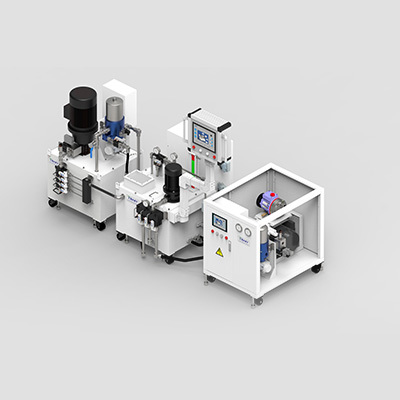
High-pressure cooling systems are mainly composed of coolant, pumps, pipes, and radiators. During operation, the pump draws coolant from the tank and transports it through pipes to the equipment or machinery that needs cooling. The coolant flows under high pressure, absorbing the heat generated by the equipment or machinery, and then dissipates the heat through the radiator, thereby achieving the cooling effect.
II. Application Fields of High-Pressure Cooling Systems
Petrochemical Industry: In petrochemical production, high-pressure cooling systems are widely used in various reactors and heat exchangers. These devices generate a large amount of heat during operation, requiring high-pressure cooling systems to ensure the normal operation of the equipment and stable product production.
Power Industry: In thermal power plants, high-pressure cooling systems are used to cool key equipment such as generators and steam turbines. In addition, the reactors in nuclear power plants also require high-pressure cooling systems to maintain a stable operating temperature.
Steel Industry: During steel production, equipment such as blast furnaces and converters generate extremely high temperatures. High-pressure cooling systems can effectively reduce the temperature of these equipment, ensuring the smooth progress of the production process.
Food Processing and Pharmaceuticals: In these industries, high-pressure cooling systems are mainly used to ensure the quality and safety of products during processing and storage. For example, in pharmaceutical manufacturing, high-pressure cooling systems can prevent drugs from deteriorating due to high temperatures.
III. Development Trends of High-Pressure Cooling Systems
With the advancement of technology, high-pressure cooling systems are also constantly developing. In the future, high-pressure cooling systems may develop in the following directions:
High Efficiency and Energy Saving: With increasing environmental awareness, future high-pressure cooling systems may place more emphasis on energy saving. Higher cooling efficiency and lower energy consumption can be achieved by optimizing coolant formulations, improving pump efficiency, and improving radiator design.
Intelligent Management: With the development of Internet of Things and artificial intelligence technologies, future high-pressure cooling systems may achieve intelligent management. By monitoring the temperature, pressure, and other parameters of the equipment in real time, potential problems can be identified and warnings issued in a timely manner. At the same time, intelligent high-pressure cooling systems can automatically adjust the coolant flow rate and temperature according to actual needs to achieve more precise cooling control.
Green and Environmental Protection: Future high-pressure cooling systems may pay more attention to environmental protection. By using environmentally friendly coolants and reducing waste heat emissions, environmental pollution can be reduced. In addition, some new high-pressure cooling systems may adopt natural cooling technologies, such as using groundwater or air for cooling, to reduce environmental impact.
In summary, high-pressure cooling systems play a vital role in modern industry. With continuous technological advancements and expanding application fields, future high-pressure cooling systems will be more efficient, intelligent, and environmentally friendly, providing better support and guarantees for industrial development.


Products

Industry Applications

Technical Service

About Us

Contact Us
Service Hotline: ( 86 ) 411-88705800 Add: Building 1, No. 10-5 ShuangD-Port Fifth Street, Dalian Economic and Technological Development Zone
Copyright © 2022 Dalian Really Fluid Technology Co., Ltd Powered by www.300.cn Seo Business License